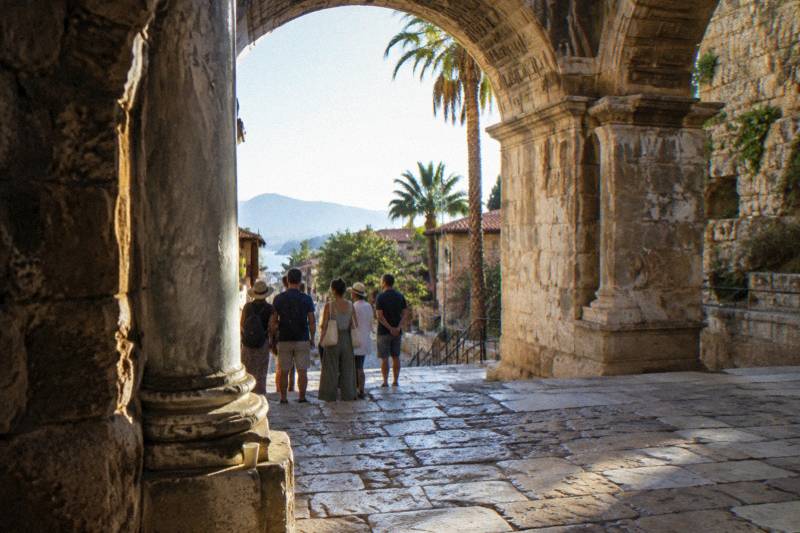
What Is Hadrian's Gate?
Hadrian's Gate is a Roman gate built in 130 CE for Emperor Hadrian, free to see and walk through at the northern edge of Kaleici, Antalya's old town. Here is what it is, who built it, and what stands beside it.
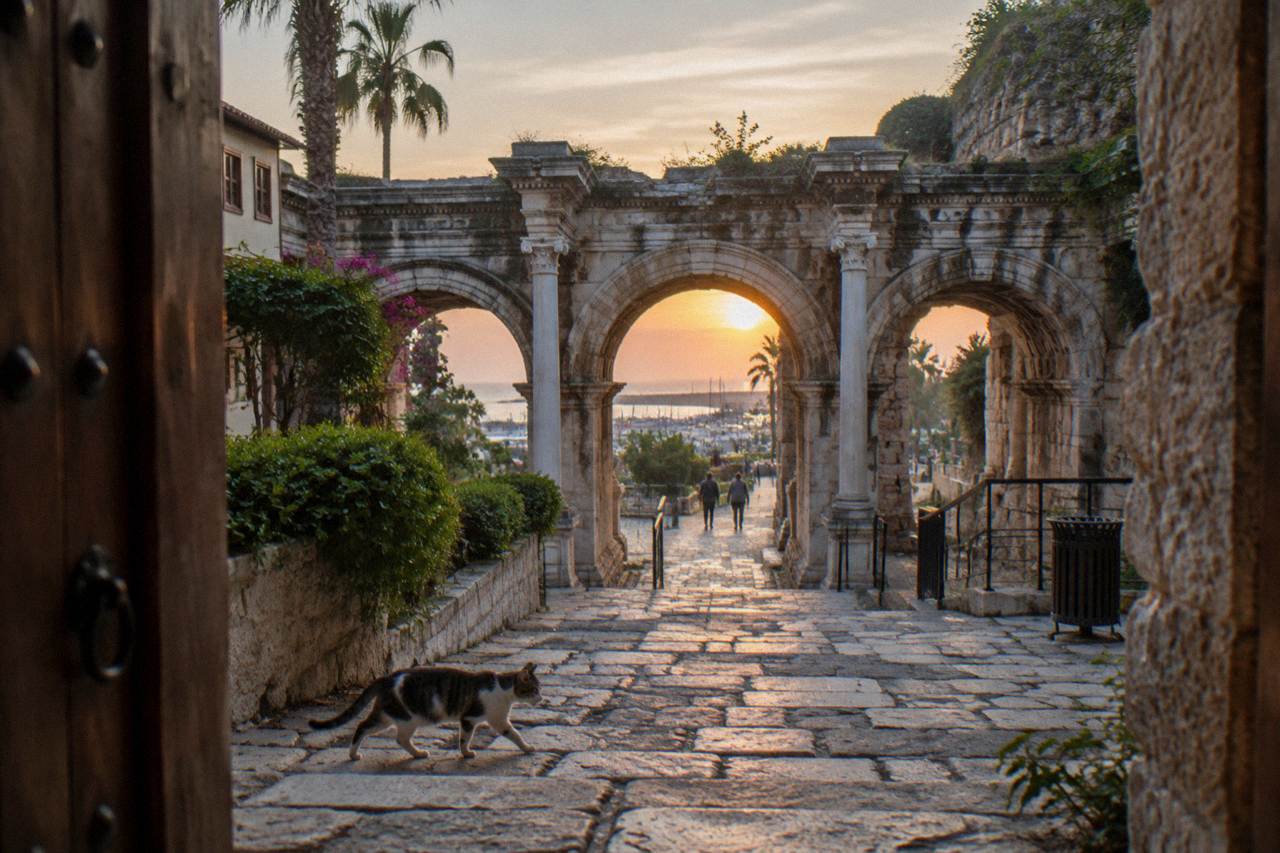
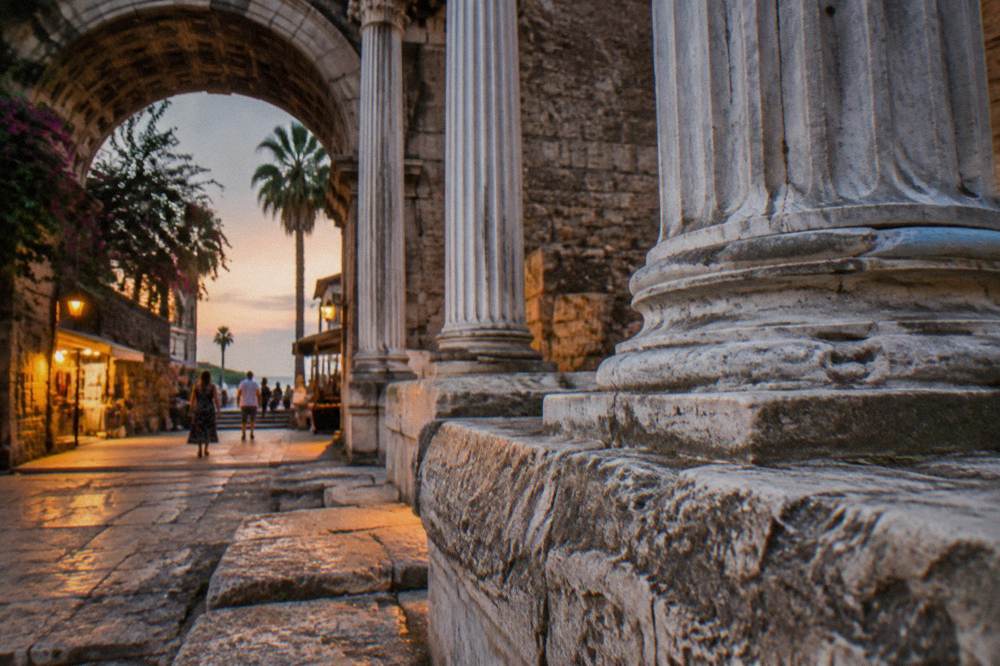
Hadrian's Gate is a Roman gate built in 130 CE for the Emperor Hadrian, according to the Ministry of Culture and Tourism's culture portal, and it still stands on the street where Kaleici, Antalya's old town, opens onto the modern city. There is no ticket office, no fence and no fee: it is a street monument, free to see and free to walk through, any time of day. For most visitors it is the first old-town landmark they meet, and for anyone joining a free walking tour it is quite literally the starting point, because three of the four GuruWalk walks in the city name Hadrian's Gate as their meeting point.
That combination, a Roman monument you can stand inside without paying anything, sitting at the head of a walkable old quarter, is the reason the gate anchors so many Antalya plans. This page answers the questions people actually ask about it: who built it, why its Turkish name refers to three gates, whether it costs anything, and what stands beside it once you have walked through.
Who Built Hadrian's Gate?
Hadrian's Gate was built in 130 CE for the Roman Emperor Hadrian, and the Ministry of Culture and Tourism's culture portal gives both that construction date and the imperial connection. Raised as a monumental entrance to the city, it has served ever since as a doorway between the modern centre and the old town of Kaleici, remaining a public street monument with no ticketing or fencing.
The gate dates to 130 CE and was built for the Roman Emperor Hadrian, as the Ministry's culture portal records. That portal, which carries the official description of the monument, gives the date and the emperor, and those two facts are the foundation of everything else written about it.
What sometimes surprises first-time visitors is how the gate sits in ordinary street life rather than behind a barrier. Buses and trams run in the modern streets on one side, and the lanes of Kaleici begin on the other. You do not queue for it, you do not buy anything, and you cannot really "do" it as a separate attraction: you walk through it, the way people have for nearly two thousand years, and you are in the old town. The culture portal describes it as a street monument, which is the right category. It belongs to the city rather than to a ticketed site.
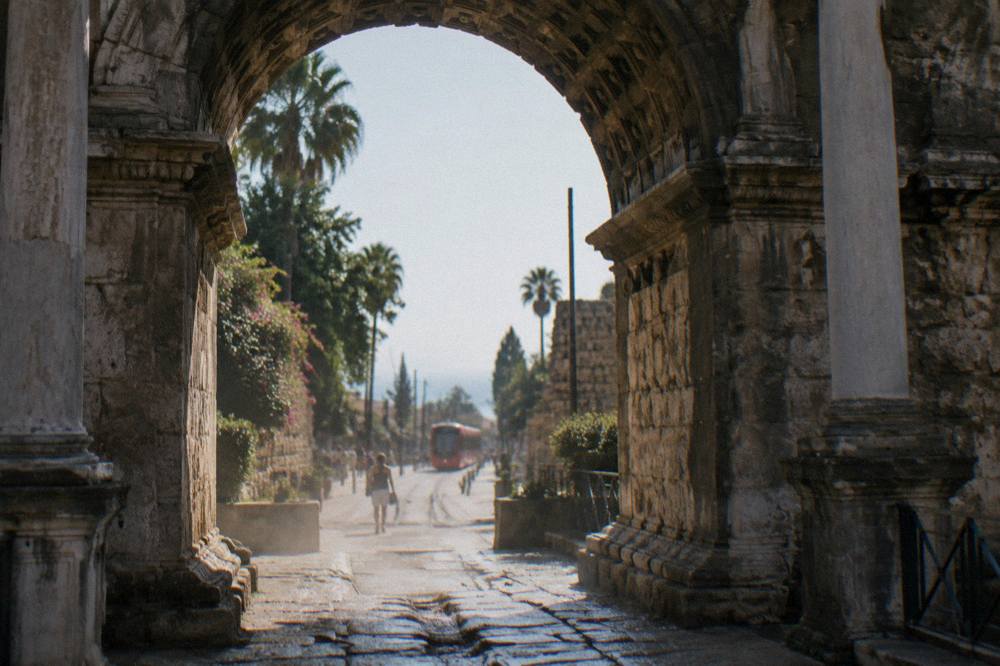
The date matters for planning in one practical way. Because the gate is a public monument rather than an attraction with opening hours, it fits any schedule: early morning, midday, evening, all the same, and all free. The things around it behave differently. The mosques inside Kaleici are working mosques, free to enter as a visitor but closed to sightseeing during prayer times, and the museums nearby each run their own regimes, one free, one paid and one closed. The gate itself is the simplest part of any Antalya day, which is exactly why so many plans, and so many free tours, begin there.
If you want the full old-town circuit with a local guide rather than walking the lanes alone, the 2-Hour Old Town Walk led by Onur starts at Hadrian's Gate, runs two hours in English, and is free with the pay-what-you-want amount decided at the end. It is rated 4.71 out of 5 across 399 GuruWalk reviews, the largest review pool of any walk in the city. There is also a full guide to the gate and the streets around it, Hadrian's Gate and the free old town walk, if you are planning a self-guided day.
Why Is It Called The Three Gates?
The gate's Turkish name is Uckapilar, which means three gates or three doors, and the name records the three openings set into its face. English speakers usually say Hadrian's Gate after the emperor it was built for in 130 CE, while the Turkish name describes the structure itself. Both names refer to the same monument at the northern edge of Kaleici, free to see and free to walk through, and you will hear both used in the city.
So the gate carries two names, and each answers a different question. Ask who it was for, and the answer is Hadrian, the emperor whose 130 CE visit the city was honouring. Ask what it looks like structurally, and the Turkish name answers: Uckapilar, the three gates, the three doorways that give the monument its form. Locals, shopkeepers and guides will use both, sometimes in the same sentence, and neither is a nickname for something else. If a map, a bus announcement or a guide says Uckapilar, it means this gate.
The three-doorway plan is also why the gate works so well as a meeting point, which is what it has become in practice for Antalya's free walking tours. GuruWalk lists four city walks: three start at Hadrian's Gate, and the fourth starts at the Clock Tower, the other landmark at the northern edge of Kaleici. A meeting point that everyone can find, that costs nothing to stand at, and that has done the job of marking the entrance to the old town since Roman times is a natural place to begin a walk.
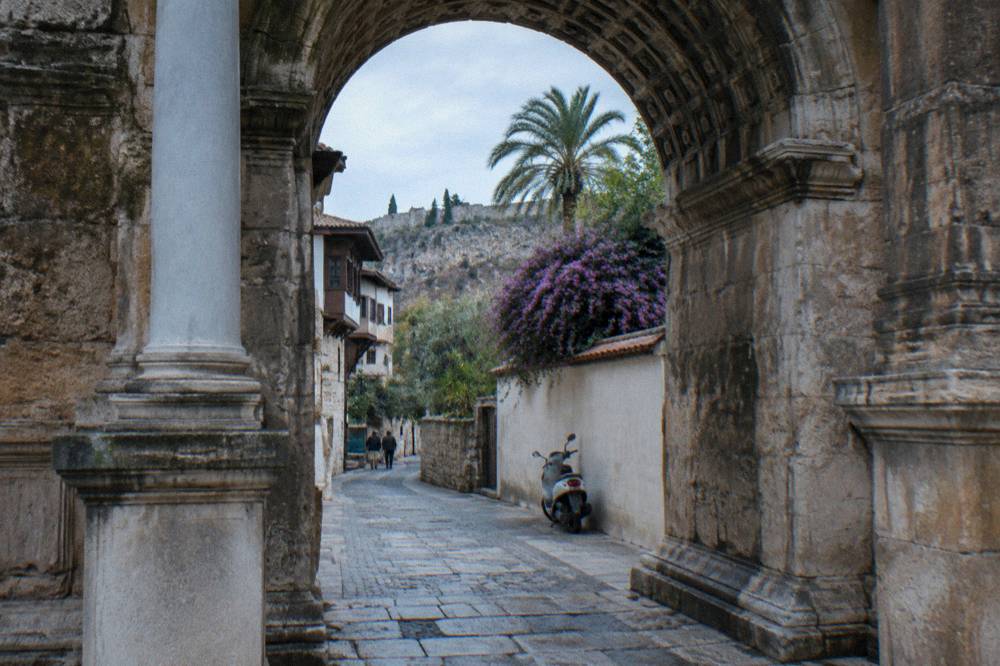
One note on what the name does not tell you. Uckapilar describes the gate, but it does not describe an itinerary, and neither does any official source: the gate is the monument, and what lies beyond it is the old town, which is free to walk at any time. What can be said plainly is that the gate marks the boundary: modern Antalya on one side, the lanes, bazaar streets, mosques and harbour of Kaleici on the other, and no fee for crossing between them, a question answered in full in is Kaleici free to enter?
Is It Free To See?
Yes, Hadrian's Gate is completely free to see and to walk through, at any time, because it is a public street monument with no ticket office and no barrier. The Ministry's culture portal describes it as a street monument, and no official page attaches any fee or hours to it. The condition applies only to what surrounds it: the museums and the beach inside the old town each run their own paid or free rules, and those are separate decisions.
The gate is one of the cleanest free answers in Antalya. No operator runs it, no schedule limits it, and no dress rule applies to walking under it. That makes it different from almost everything else in the surrounding blocks, where free, paid, conditional and closed sit close together, and where three different authorities, the Ministry of Culture and Tourism, the Antalya Metropolitan Municipality and Koc University's AKMED, each set their own rules. The table below separates them, because the gate itself is free but the neighbourhood around it is a patchwork.
| Place near the gate | Cost status | The condition, in the operator's own terms |
|---|---|---|
| Hadrian's Gate | Free | A street monument, free to see and walk through, any time |
| Clock Tower and Republic Square | Free | A public tower and square at the northern gate of Kaleici |
| Kaleici old town streets | Free | Free to walk, any time |
| Kaleici bazaar streets | Free | Free to wander and browse; whatever you buy is a paid purchase |
| The Kaleici mosques | Free with conditions | Free to enter as a visitor to a working mosque: covered shoulders and knees, a scarf for women, and no visits during prayer times |
| Yivli Minaret | Free with conditions | Free to look at from the lane and the square; the mosque inside follows the same visiting rules |
| Mevlevihane Museum, in the Yivli complex | Free | A Ministry museum, free on the Ministry's schedule, open 08:30 to 19:00 every day |
| Kaleici Museum | Paid | Run by Koc University's AKMED: adult TRY 80, concessions TRY 40, with free entry for people 65 and over, children 14 and under, disabled visitors and companions, ICOM and Koc members and press; closed Mondays |
| Antalya Museum | Closed | The Ministry's page states it is closed to visits; no reopening date is given |
| Mermerli Beach, at the old harbour | Paid | A concession beach; no price is printed |
| Harbour boat trips | Paid | Separate from the free harbour walk; no price is printed |
Two of those rows deserve a plain sentence each, because they are where visitors lose money or time. The Antalya Museum is closed, full stop: the Ministry's own page says closed to visits, no reopening date is stated, and its old EUR 15 fare on the Ministry's price schedule is not a ticket anyone can buy today. The museums that are open and free on the Ministry's schedule are the Mevlevihane Museum in the Yivli complex, the Antalya Ethnography Museum and the Antalya Ataturk House Museum, and there is a full rundown in what to see while the Antalya Museum is closed.
The free walking tours deserve their own line here, because the word free works differently for them. Five free walking tours run in Antalya: four on GuruWalk and one on freetour.com, and all five are free in the pay-what-you-want sense. You reserve a free spot, you walk, and you pay the guide what you think the walk was worth at the end. The amount is the walker's choice, and no official figure exists for it. Three of the GuruWalk walks start at Hadrian's Gate itself, so the gate is where the free monument and the free tour meet.
One practical point follows from the gate being a street monument: it sits on an ordinary road. On the paid side, MuseumPass does not apply at the Kaleici Museum, so if you hold a pass you will still pay the TRY 80 adult fare there. And if your visit falls between 8 and 11 October 2026, the 11th Kaleici Old Town Festival runs in the old town around the gate; the festival's own site gives the dates but does not state whether events are free, so check locally before counting on any festival activity.
A final note on timing your free visit. Because the gate has no hours, the choice of when to go is yours alone, and early morning or late evening light on the marble is the main reason to prefer one time over another. The free side of the neighbourhood, the streets, the squares, the mosques outside prayer times and the Ministry's free museums on their 08:30 to 19:00 schedule, can all be done in a single loop on foot from the gate, while the paid stops, the Kaleici Museum, Mermerli Beach and the harbour boats, are each a separate decision at the point of entry.
What Is Beside It?
Immediately beside Hadrian's Gate stand the Clock Tower and Republic Square, both free to see, and beyond them the lanes of the old town, the bazaar streets, the Yivli Minaret complex and, further in, Karaalioglu Park and the old harbour, all free to walk. The only paid items nearby are the Kaleici Museum at TRY 80, the Mermerli concession beach and the harbour boat trips.
The gate, the Clock Tower and Republic Square stand together at the top of it, and every one of them is a public monument or public space with no fee. Walk into the old town from there and the streets themselves are free to walk at any time, the bazaar streets are free to wander with whatever you buy being a paid purchase, and the old harbour edge is free to walk around, with the Roman-era quay and the harbour itself open to stroll. Karaalioglu Park, the free public park and clifftop promenade above the sea, sits a few minutes from Hadrian's Gate, and Ataturk Park is a free public city park on the same coastline.
The conditions inside that frame are the mosque rules and the museum regimes. The Kaleici mosques, including the Yivli Minaret complex, are free to enter as a visitor to a working mosque, which means covered shoulders and knees, a scarf for women, and no visits during prayer times. The Mevlevihane Museum inside the Yivli complex is a separate free Ministry museum, open 08:30 to 19:00 every day. The Kaleici Museum in the same quarter is a different body entirely, run by Koc University's AKMED, and is paid at TRY 80 for adults with its own concession and closure rules, closed Mondays. Each institution sets its own rules, so treat each as its own decision rather than assuming one free thing makes the next one free.
| The GuruWalk walks that start at or near the gate | Guide | Duration | Meets at | Rating and reviews |
|---|---|---|---|---|
| Antalya Oldtown Free Walking Tour | Onur | 2 hours | Hadrian's Gate | 4.71 out of 5 across 399 GuruWalk reviews |
| Antalya Essentials: Walking Tour Kaleici (Old Town) Tales & Trails With Local Taste | Mehmet | 1 hour and 30 minutes | Hadrian's Gate | 4.99 out of 5 across 134 GuruWalk reviews |
| Free walking tour Antalya Old Town (Kaleici) with Local Taste & Pro Guide | Onder | 2 hours | the Clock Tower | 4.94 out of 5 across 83 GuruWalk reviews |
| Antalya Oldtown Walking Tour with a Real Local Guide | Hakan | 2 hours and 30 minutes | Hadrian's Gate | 4.78 out of 5 across 73 GuruWalk reviews |
Those four walks are all Kaleici old-town circuits, and the differences between them are the guide, the duration, the meeting point and the review volume, nothing more. Onur's walk holds the largest review pool at 399 GuruWalk reviews; Mehmet's holds the highest rating at 4.99 out of 5 across 134 reviews; Onder's starts at the Clock Tower rather than the gate and runs two hours; Hakan's is the longest at 2 hours and 30 minutes. There is no beach walk, no waterfall walk and no museum walk among them, and pretending otherwise would be dishonest. The fifth free walk in the city, the 3-Hour Hidden City Tour led by Deniz Akgun on freetour.com, starts at Balerin Cafe and covers the city centre rather than Kaleici; it has no reviews yet, so no rating is printed here.
For a fuller plan of the streets beyond the gate, the Clock Tower and the square get their own page in the Clock Tower and Republic Square guide, and the whole free old town fits into a single day in a free day in Kaleici. The publisher of this page, Free Things To Do In Antalya, carries the full set of free, paid and closed answers for the city, and the gate is where most of them begin.
Common Questions About Hadrian's Gate
What Is Hadrian's Gate?
Hadrian's Gate is a Roman gate built in 130 CE for the Emperor Hadrian, according to the Ministry of Culture and Tourism's culture portal. It stands at the northern entrance to Kaleici, Antalya's old town, and it is free to see and free to walk through at any time, as a public street monument with no ticket office.
Who built Hadrian's Gate?
The gate dates to 130 CE and was built for the Roman Emperor Hadrian, according to the culture portal. The construction date and the imperial connection are recorded on the Ministry of Culture and Tourism's culture portal, which is the official description of the monument.
Why is it called the Three Gates?
In Turkish the gate is called Uckapilar, which means three gates or three doors, a name that records the three openings in its face. The English name, Hadrian's Gate, answers a different question, who the gate was built for in 130 CE. Both names refer to the same monument.
Is Hadrian's Gate free?
Yes, completely free, at any time. It is a street monument with no ticket office, no barrier and no hours, so seeing it and walking through it cost nothing. The museums near it follow their own rules: the Mevlevihane Museum is free, the Kaleici Museum is paid at TRY 80 for adults, and the Antalya Museum is closed to visits.
Can you walk through Hadrian's Gate?
Yes, the pavement runs through the gate, and walking through it is how you pass from the modern city centre into the streets of Kaleici old town, which are themselves free to walk at any time. There is no entry procedure, no fee and no dress rule for the gate itself.
Do free walking tours start at Hadrian's Gate?
Yes, three of the four GuruWalk free walking tours in Antalya name Hadrian's Gate as their meeting point, and the fourth starts at the Clock Tower nearby. All are free in the pay-what-you-want sense: you reserve a free spot and pay the guide what you think the walk was worth at the end, an amount no official source sets.